
I still remember the first time I stared at my Alear’s stats, feeling completely stuck. My squad had a glaring hole where a sturdy tank should be, and no amount of regular leveling was fixing it. That’s when a buddy clued me in on Second Seals, and honestly, it was a total lightbulb moment. Fast forward to 2026, and even with all the DLC waves and balance patches, this little item has never stopped being the glue that holds my best runs together. It’s one of those mechanics that turns a good strategy RPG into a borderline obsession.
So what exactly are these magical slips of parchment? In plain English, a Second Seal lets you completely rework a unit’s base class. While a Master Seal pushes a character from a basic class into an advanced one, a Second Seal is the tool that says, “Nah, let’s try something different.” It’s the ultimate reset button. You can take your sword-swinging hero and turn them into a lance-wielding cavalry beast, or flip a squishy mage into an armored wall. The only real limit is your imagination—and maybe your wallet. Over the years, I’ve learned that smart use of Second Seals is what separates a good playthrough from a genuinely broken one. You can patch up any weakness in your formation, or go full meme-build just for the fun of it.
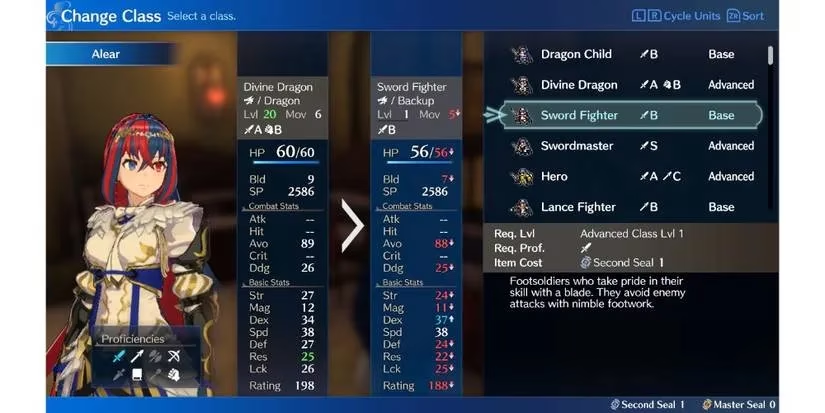
Back in the day, I kept banging my head against Chapter 17 because I had zero high-resistance units. One Second Seal on my Framme turned her from a staff bot into a martial master with respectable bulk, and suddenly the map felt like a breeze. That flexibility is why vets like me hoard these things like gold dust. They’re also clutch when you realize some inherited skills clash with a unit’s original class. Why keep Luna on a character who can’t trigger it properly? Slap a Second Seal, reclass into something with better synergy, and watch the damage numbers go brrrr. It’s a no-brainer.
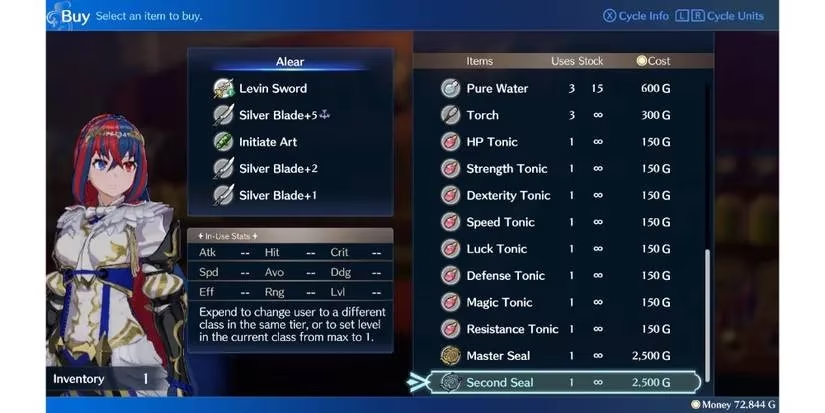
Of course, knowing where to snag these seals is half the battle. By 2026, most of us have memorized the routes, but for anyone dusting off the game after enjoying Engage’s legacy, here’s the lowdown. The easiest method is the Item Shop, which starts stocking them after Chapter 13: Heroes of the Oasis. Each costs 2,500 Gold, which is honestly a bargain considering the power spike. I usually burn all my early-game gold on a handful just to experiment. The stock refreshes as you progress, so you’re never permanently locked out.
If you’re more of a treasure hunter, keep your eyes peeled for chests during story battles and skirmishes. I’ve lost count of how many times a random drop saved a ironman run. There’s something deeply satisfying about opening a chest, seeing that Second Seal pop out, and immediately plotting your next class roulette. The third reliable source is the Paralogue side quests tied to each Emblem. They’re not guaranteed, but the drop rate feels generous enough that knocking out a few early in a fresh file can set you up for the rest of the game. In the current 2026 landscape, where the meta has evolved around optimized pairings like Corrin’s debuff shenanigans or Byleth’s dance shenanigans, having a stash of these seals early on is like stealing candy from a baby.
Here’s a hot tip from someone who’s been in the trenches too long: don’t sleep on the synergy between Second Seals and the Tower of Trials. Blasting through tempest trials for bond fragments while tailoring each unit’s class to the challenge is chef’s kiss. I once ran a full team of heroes reclassed into snipers just to see how far the chip damage could go, and it was ridiculously fun. Even in 2026, the freedom that Second Seals provide keeps the game fresh. New players hopping in because of the recent Switch 2 graphical updates might get overwhelmed by all the systems, but trust me—master the Second Seal, and you’ll soon be cooking with gas. Just keep a few spares in your inventory, because you never know when a wild challenge run idea will strike.