
Back in 2023, Fire Emblem Engage pulled off a trick so delightfully meta that it felt like the series had briefly turned into a grand interdimensional costume party. The Emblem Rings allowed characters to summon the spirits of heroes from past Fire Emblem games, borrowing their skills and signature weapons as if borrowing a favourite jacket from an older sibling. If that sounds like the sort of thing that could make a Persona game blush with envy, it is because, to any fan of Atlus\u2019s modern classic, the resemblance is uncanny. Now, with Persona 6 looming on the 2026 horizon like a velvet-clad storm, it is time to ask the obvious question: why on earth hasn\u2019t the series already raided that particular toy box?
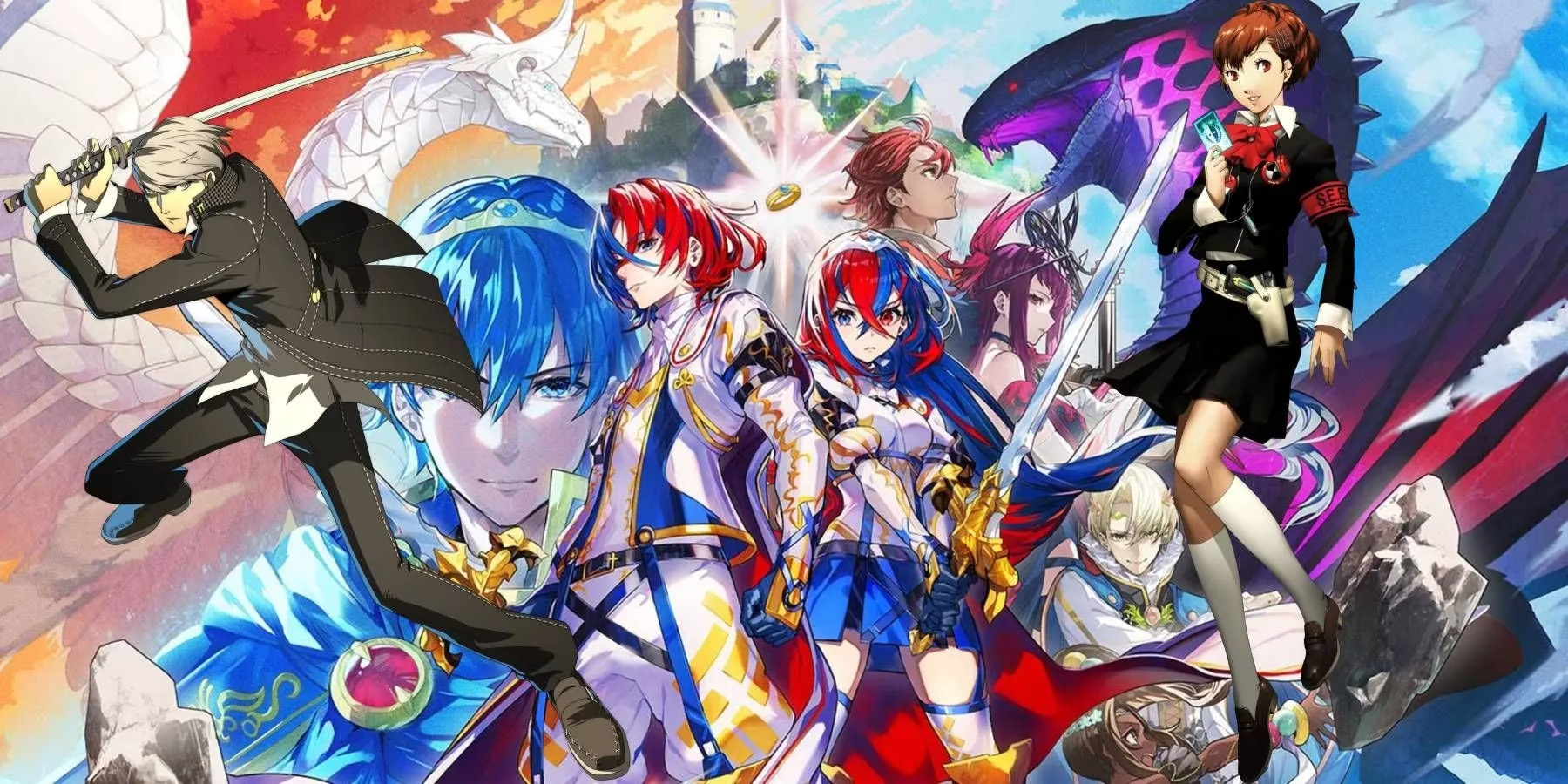
The core gimmick of Engage operates like a spiritual jukebox of heroes, each ring containing not just a stat boost but a full-blown memory of a legendary warrior. When a character equips one, they momentarily become a vessel for someone like Marth or Lyn, mixing their own fighting style with the essence of a bygone era. For a franchise that already deals with the summoning of mythological figures through tarot cards and psychological awakening, this is less a stretch and more a polite invitation. Persona has always been about high schoolers ripping masks off their psyches to summon inner demons\u2014literally\u2014so the idea of reaching out to past protagonists instead of mythical beasts would merely trade one flavour of Jungian archetype for another.
The comparison gets even juicier when you realise that Emblem Rings are, in a way, a defamiliarised version of the Wild Card ability. In Persona, the protagonist can swap Personas like a fashionista changes outfits, blending resistances and skills on the fly. The Emblems function similarly, bestowing a curated skill set upon their wearer without the hassle of fusion accidents or grinding in Mementos. One might say the rings are like ancestral hard drives, storing the greatest hits of character builds across the franchise\u2019s history, ready to be plugged into any willing USB port of a new protagonist. That metaphor may spark a blue screen of death for some readers, but it holds a peculiar charge in an age where digital memory is the new soul.
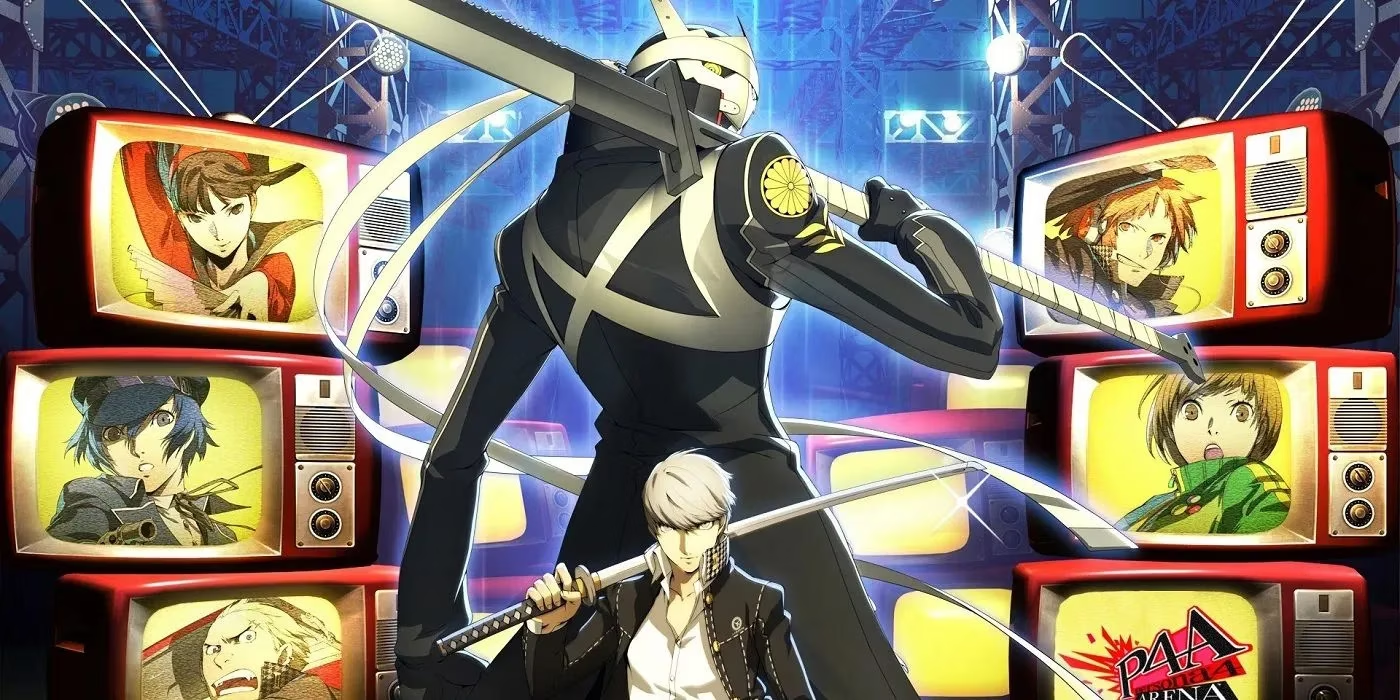
For Persona 6, which by now has been confirmed for years and danced tantalisingly around release rumours, a similar mechanic would be nothing short of a revolution wrapped in nostalgia. Imagine if the new cast could don a spectral mantle that channels the essence of previous Persona leads. Not just the obvious stars like Yu Narukami or Joker, but the full pantheon: Tatsuya Suou bleeding time-freeze abilities into a combat round, Maya Amano pouring her eternal optimism into a game-breaking support spell, or even the blank-faced protagonists of the early titles, whose silence spoke louder than any voiced line. The system would not merely be a power-up; it would be an archaeological dig where the artefacts fight back, each past hero a living relic that reshapes the battlefield.
Critics might raise an eyebrow at the suggestion that Persona, already a series drenched in psychological symbolism, should borrow from a fantasy tactics game. Yet consider the thematic fit. The Velvet Room has always functioned as a liminal space between consciousness and the collective unconscious, a sort of cosmic waiting lounge where velvet chairs outnumber the exits. Hitching a ride on the spirits of previous heroes fits perfectly with the notion that every new Wild Card is not truly alone; they stand on the shoulders of those who came before. In Fire Emblem Engage, the Emblems are literally rings, tokens of commitment and memory. In Persona, they could manifest as shattered masks, old tarot cards, or\u2014to employ a less common simile\u2014bottled laughter from a timeline that no longer exists, uncorked in moments of peril to remind the current cast that their struggles have ancient echoes.
What makes this idea especially potent in 2026 is the sheer weight of Persona\u2019s accumulated history. The series spans multiple console generations, spin-offs, and even crossover fighting games that already toyed with the concept of legacy characters clashing. Atlus has never been shy about celebrating its own past, yet it has also been cautious not to let nostalgia overshadow innovation. A system inspired by Engage could bridge that divide by making the legacy a gameplay pillar rather than a mere fanservice cameo. It would turn Persona 6\u2019s new theme\u2014whatever that theme might be; the rumour mill is quieter than a Shadow\u2019s whisper\u2014into a tapestry woven from the threads of every previous journey.
There is also the gleeful possibility of casting a wider net beyond just Persona. The Emblem Rings in Fire Emblem opened the door to a kingdom of \u201cwhat if,\u201d and Atlus could go even further by inviting characters from the broader Shin Megami Tensei mythos. Imagine a ring that channels Demi-fiend\u2019s razor-edged smirk, or Raidou Kuzunoha\u2019s detective instincts. This would be less a crossover and more a philosophical summit, where the very concept of protagonists meets in a psychic arena. For a series that has always flirted with the idea of multiple realities and cognitive worlds, the only surprising thing is that it took over a decade for someone to propose combining them all into one mechanic.
Of course, the writers would need to cook up a justification. Perhaps the collective unconscious has become cluttered with the minds of former heroes, their identities crystallised into cognitive artefacts after their stories ended. Or maybe the new Velvet Room attendant\u2014who by now must be a deeply eccentric being with a penchant for cryptic advice and impossibly tailored suits\u2014will hand over a \u201cLegacy Tarot\u201d that allows the protagonist to briefly commune with the archetypal Fool from previous cycles. The narrative could even make this borrowing a risk: leaning too heavily on a past hero might corrupt the user\u2019s own sense of self, adding a delicious tension between the comfort of nostalgia and the necessity of forging one\u2019s own path.
Ultimately, the Persona series has always thrived on reinventing its premise while keeping the core of teenage angst and fusion-based combat intact. By 2026, with Persona 6 presumably aiming to shake up the formula as much as its predecessors did, a dash of Fire Emblem Engage\u2019s magic could be the secret ingredient. It would be a paradoxical flourish: an homage to the past that pushes the series forward, much like the Fool\u2019s journey itself. All it takes is a little ring, a lot of memory, and the courage to admit that borrowing from a fellow JRPG heavyweight might just be the most Persona thing Persona could do.