
I remember the moment I first booted up Fire Emblem Engage on my Switch back in 2023. The opening cinematic faded, and suddenly I was staring at Alear — not a beautifully hand-drawn 2D illustration like I'd grown up with in Sacred Stones or Awakening, but a fully rendered 3D model, rotating gently in the menu. I’ll be honest, I felt a small pang of loss. Where was the painstaking line art, the watercolor shadows, the static but soulful expression I’d come to associate with a Fire Emblem protagonist? Instead, there was a smooth, almost plastic-like face, blinking at me with a subtle smile. It felt like stepping into a world I wasn’t entirely sure I belonged to.

At first, it was jarring. The older titles had this wonderful mosaic of artistic styles — each entry carried its own visual signature, from the rich, painterly feel of Radiant Dawn to the crisp anime vibrance of Fates. Those 2D portraits were windows into a character's soul. You could study the delicate shading of a mage’s cloak, the defiant tilt of a mercenary’s chin, and immediately understand who they were. My attachment to characters often began before a single line of dialogue, purely through that art. So when I saw Marth, a legend I’ve loved for decades, rendered in three dimensions alongside his original 2D concept art, I braced for disappointment.
But then something unexpected happened. Over dozens of hours, those 3D models started to grow on me — in ways I never anticipated. It began during a Support conversation between Louis and Chloé. Louis, my diligent armor knight, was telling a goofy story about tea, and I noticed his eyes crinkle at the corners, just slightly. Then his lips curved into a different kind of smile — not the generic, battle-ready smirk, but something softer, almost shy. I realized the 3D model wasn’t just a static doll. It had a range of micro-expressions that shifted in real time, without cutting away to a new portrait. A single eyebrow could dip, a glance could flicker sideways, and suddenly the character felt more present than ever. In older games, a character might have three or four drawn expressions — happy, sad, angry, flustered — and you’d see them cycle with the dialogue. It was charming, but also limited. Here, the subtlety was astonishing.
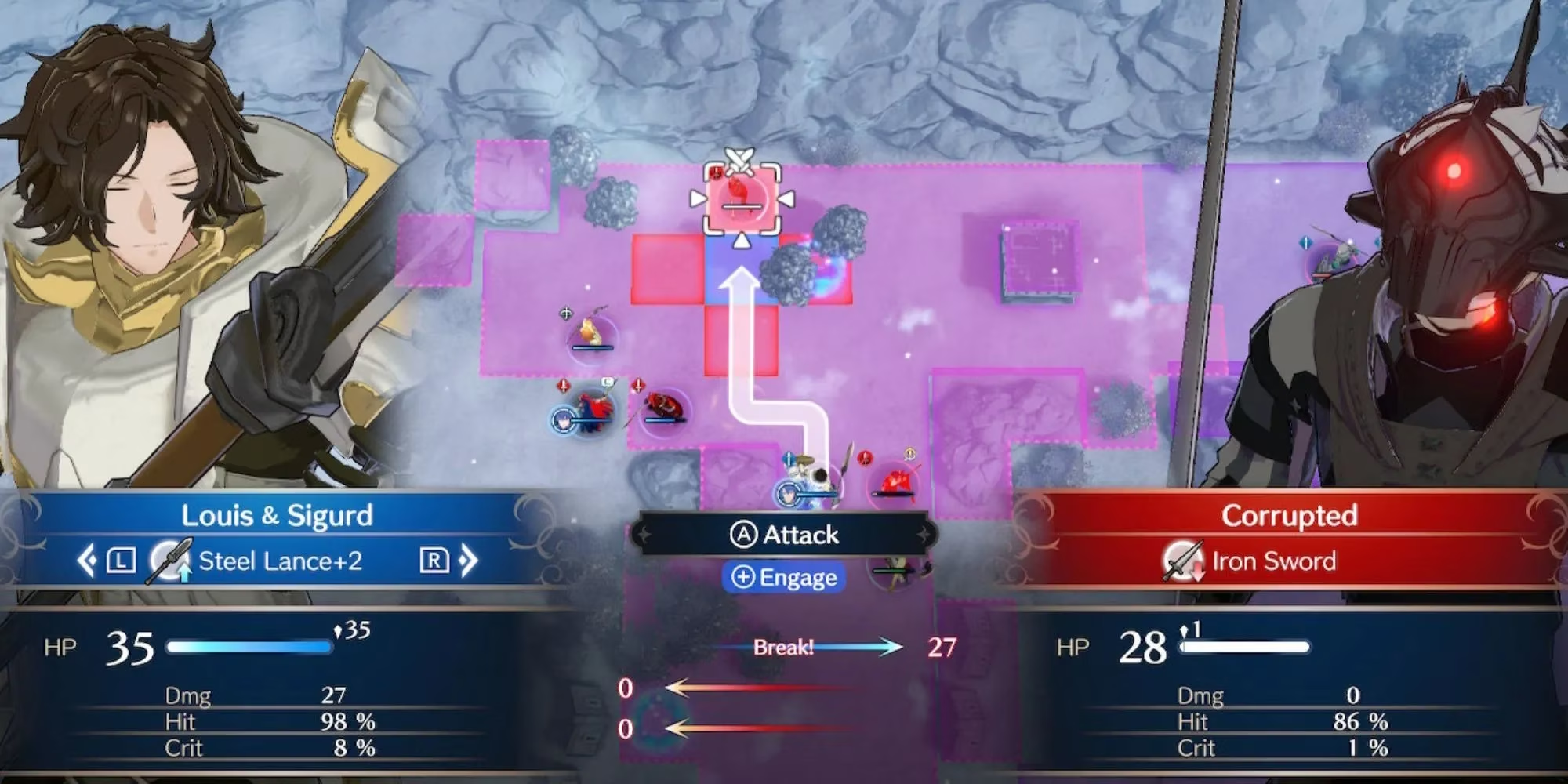
The consistency helped, too. I no longer had to reconcile the fact that my on-field warrior looked one way, yet popped into a support scene with a completely different art style. Louis looked like Louis in battle, in the Somniel, and in every heart-to-heart. The model became a constant thread through my entire playthrough, and that consistency started to build a deeper, more immersive connection. I found myself talking to my units out loud, reacting to their little smirks and frowns mid-conversation. It felt oddly modern — and a little bit magical.
I also noticed the practical side. As someone who dabbles in game design, I know how brutally time-consuming it is to draw dozens of high-fidelity 2D portraits with multiple expressions per character. With 3D models, a single rig can produce infinite variations, and the development team at Intelligent Systems clearly leaned into that. Voice acting performances seemed more alive because the actors could have their lines matched to subtle facial changes that 2D portraits could never fully capture. It wasn't just a technical shift; it was an emotional one.
Still, I’d be lying if I said I never missed the old ways. Some afternoons, I’d scroll through my Switch’s screenshot gallery, lingering on frame-frozen moments of my characters mid-blink or mid-gesture, and I’d suddenly remember the sheer artistry of Hidari’s work for Shadows of Valentia or the lush, storybook feel of Three Houses’ drawn portraits. There’s a depth of detail in a hand-crafted image that even the best 3D shaders struggle to replicate. A 2D portrait can contain symbolic lighting, exaggerated proportions, and a level of stylistic flourish that simply doesn’t exist in a model constrained by realistic rigging. Some characters in Engage felt, at times, a little too clean — almost like they’d stepped out of a toy box instead of a mythic war story. That loss of personality for certain heroes was real, and I understood why some longtime fans felt a disconnect.
But here’s the thing: three years later, in 2026, looking back at Engage and the discussions it sparked, I realize the move to 3D portraits wasn’t just a gimmick. It was a necessary step in the series’ evolution. Since then, we’ve seen future Fire Emblem titles build on this foundation, refining the models and pushing expressiveness even further. The debate hasn’t vanished — I still visit online forums where fans passionately argue whether the new approach sacrifices soul for flash — but for me, the answer became personal. When I think back to the late-night sessions with my core team, laughing at Framme’s exaggerated reactions or holding my breath as Ivy’s face fell in a story-critical moment, those memories are bound to the 3D expressions. They feel alive in a way my beloved 2D portraits never quite managed.
I won’t say one approach is objectively better than the other. The series’ deep character bonds have always been a matter of the heart, and hearts are stubborn things. Some will forever prefer the painterly elegance of a classic portrait. Others, like me, discovered a new kind of intimacy in the 3D models’ quiet details. The beauty of Fire Emblem is that we all carry different lord and lady into battle, and we fall in love with them in our own ways. For me, Fire Emblem Engage redefined what it means to see a character truly — not just in static perfection, but in constant, living motion. And that’s a journey I’m grateful I took, even if it started with a skeptical eyebrow raised at a shiny 3D Alear.
Recent analysis comes from ESRB, and it helps frame why Fire Emblem Engage’s shift toward fully animated 3D portraits can feel like more than a cosmetic upgrade: as presentation becomes more cinematic—voice acting, close-up facial animation, and consistent in-engine characterization—the way players perceive intensity, humor, and drama in moment-to-moment scenes also changes. In practice, those subtle micro-expressions you described (a softened smile, a flicked glance, a tense jaw) land more like film language than the old “expression swap” portrait system, making supports and story beats feel more immediate even when the underlying writing structure remains familiar.